


Record homelessness levels across England
26 February 2026
Recent Government figures show that homelessness in England continues to rise, with record numbers of people sleeping rough and families living in temporary accommodation.
The latest annual rough sleeping snapshot estimates that 4,793 people slept rough on a single night in Autumn 2025 — the highest number on record. This is up from 4,667 the previous year and represents a 56% increase compared with three years ago.
How the rough sleeping snapshot works
The rough sleeping snapshot is carried out by local authorities across England on a single night in the autumn. Councils either conduct physical street counts or produce evidence-based estimates, using information from outreach teams, charities, community groups, faith organisations, police, and other frontline services.
The snapshot includes people who are:
- Sleeping outside, in parks, streets, bus shelters, or doorways,
- Staying in tents, cars, makeshift shelters, or other places not meant for habitation,
- Bedding down for the night or about to do so during the count period.
It does not include people who are:
- Staying in hostels or supported accommodation,
- In temporary accommodation arranged by the council,
- “Sofa surfing” with friends or family,
- Or otherwise hidden and not identified through local intelligence.
As it measures a single night, the snapshot provides a point-in-time estimate rather than capturing everyone who experiences rough sleeping over a year. Women in particular may be undercounted, as some take steps to remain out of sight.
Local snapshot: Newbury and West Berkshire
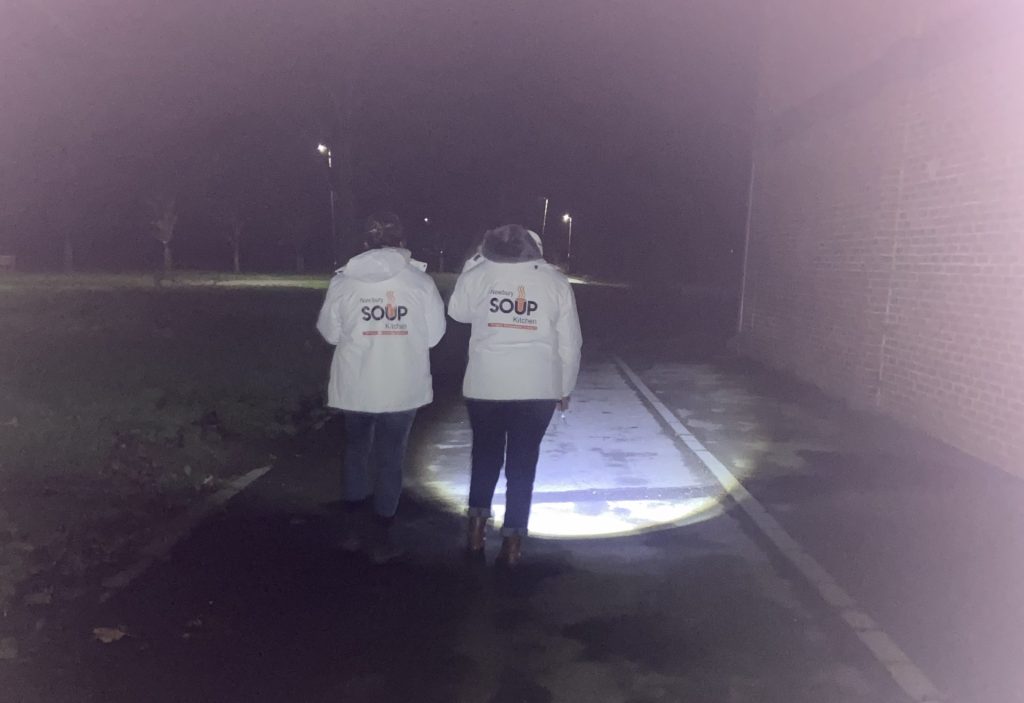
In November 2025, our team went out across West Berkshire, including Newbury, supporting council staff during the annual snapshot. Around 2 a.m. on a wet, cold night, we walked key streets, alleys, parks, and other known locations where people may be bedding down.
The count was supported by outreach workers and local volunteers, helping ensure that anyone sleeping rough in the area was identified and recorded. While numbers locally were lower than national totals, the snapshot highlighted the presence of both men and women sleeping outdoors, often in concealed or improvised shelters to stay safe from the elements.
Our work during this night confirmed that even in smaller towns like Newbury, rough sleeping is a real challenge, particularly during the colder months. The local data feeds into national records and helps ensure that resources and support are targeted where they are most needed.
Snapshot highlights (national)
- 4,793 people slept rough on a single night in Autumn 2025, up from 3,069 three years ago.
- The number of women sleeping rough rose 8%, from 680 to 733.
- The largest regional increases were in the North East and North West. The North East rose 31% year-on-year and 158% over three years. The North West rose 20% year-on-year and 74% over three years.
Separate Government data from July to September 2025 shows that 175,990 children were living in emergency accommodation at the end of September — the 11th consecutive record high, a 7% increase on the same period in 2024.
Overall, 134,760 households are living in temporary accommodation, the highest level recorded.
Although the number of households formally assessed as homeless or at risk has fallen slightly to 81,360 (down 3%), around 900 people each day still seek support from their local council due to homelessness.
Housing supply and affordability
In the past year, just over 17,000 social homes were delivered in England, despite long-term plans for £39 billion investment in social and affordable housing. Experts estimate that 90,000 homes per year are needed to meet demand. There was a net loss of nearly 4,000 social homes, more than double the previous year.
Affordability remains a challenge: only 2.4% of private rental properties are affordable for households reliant on housing benefit.
The Government has announced over £50 million in additional funding to address rough sleeping, alongside a national homelessness strategy introduced last year aimed at reducing long-term rough sleeping and supporting people leaving institutions such as prisons and hospitals.
While the snapshot provides a useful year-on-year comparison, it captures only part of the picture. Many individuals and families experiencing housing insecurity remain outside these figures, highlighting the scale and complexity of homelessness across England.